
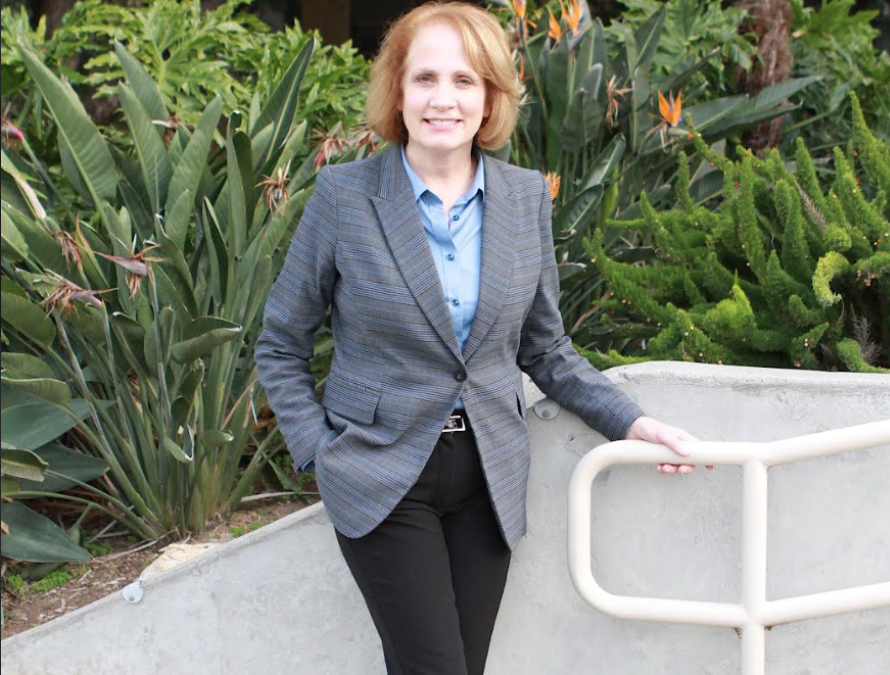
Dr. Lora Geriguis, Dean of the College of Arts and Sciences at La Sierra University, brings to her role a lifelong passion for stories—those told through literature, lived through history, and shared through education. Known for her thoughtful leadership and her deep belief in the power of learning communities, Dr. Geriguis’s journey from an inspired high school reader to an academic leader reflects her enduring commitment to curiosity, empathy, and service.
When Dr. Geriguis reflects on what first drew her to English and literature, her story begins in a high school classroom at La Sierra Academy. “We were reading The Pearl by John Steinbeck,” she recalls with a smile. “I remember being completely absorbed in the story and ready to talk about it in class. But when I got there, I realized most people weren’t as willing to converse about this book. That moment made me think, maybe I connect with this in a way that’s not shared by everyone else.”
That realization set the stage for a lifetime of curiosity, study, and teaching—a journey that would take her from her first literature class to her current role as Dean of the College of Arts and Sciences at La Sierra University.
After high school, Geriguis crossed the Atlantic to study at Newbold College in England, a small institution known for its vigorous humanities program that wove history and English together. “It was such a pleasure to be in England studying literature,” she says. “I remember a history professor who talked about American history as a series of stories—complex, layered, filled with different points of view. It changed how I thought about what history is.
One of the most influential moments of her early academic life came from a professor at Newbold. “He began his class by saying, ‘You Americans think you’ll get an A in everything. I expect you to be wrong most of the time,’” she remembers, laughing. “At first I didn’t know what to make of that, but then it hit me—he was giving us permission to be wrong. Learning wasn’t about being perfect; it was about the struggle to understand.”
That insight shaped her teaching philosophy for decades. “I’ve always leaned into that idea that learning involves struggle,” she says. “Can we, as a classroom, stand together against the idea that teachers simply pour knowledge into students? Real learning happens when we wrestle with ideas collectively, when we make mistakes and grow from them.”
Those experiences deepened her love for reading and interpretation. After two years in England, she transferred to the University of California, Riverside, where she completed her bachelor’s and later earned her Ph.D. in English. By that time, she knew that literature was more than just stories—it was a framework to understand humanity.
Her graduate years at UCR also brought lessons in empathy and fairness. Paired with a mentor who was dismissive of certain student perspectives, Geriguis learned how easily personal biases can cloud teaching. “Some students would write about Jesus or their faith, and my mentor didn’t like grading those papers, so she’d give them to me,” she says. “It taught me that as professors, we have a duty to meet students where they are. We’re responsible for helping them grow from that point, not for judging where they begin.”
Before stepping into administrative leadership, Dr. Geriguis spent many years teaching in La Sierra University’s Honors Program, where she guided students through seminars in theory and senior capstone projects. “Those classes were pure joy,” she says. “There’s something powerful about the cohort model—the same students learning together over time, supporting one another, growing as a community. They’re not cookie-cutter students; they each bring something different, and that makes the learning richer.”
One of her most memorable experiences came while teaching Octavia Butler’s Parable of the Talents. “That book was written in the 1990s but set in the 2020s, and reading it with my students felt almost prophetic,” she recalls. “We were living through some of the very challenges Butler had imagined. The students were engaged, thoughtful, and faithful readers—it was one of those golden experiences as a teacher.”
For Geriguis, the joy of teaching has always come from seeing students find their own voices. “When students share their worldviews, when they connect literature to their lived experience, that’s when the classroom comes alive,” she says. “It reminds me why I fell in love with this work in the first place.”
Over time, Dr. Geriguis began taking on new responsibilities beyond teaching—first as a mentor, then as department chair, associate dean, and eventually Dean of the College of Arts and Sciences. “Each role appealed to the puzzle-solving part of my mind,” she says. “I found satisfaction in understanding how systems work, in supporting others, in seeing how all the pieces of a university fit together.”
While she still misses the energy of the classroom, she views her administrative role as an extension of her calling as an educator. “Now, instead of working directly with students, I work with faculty who support students,” she explains. “This office exists to help faculty do their best work. It keeps me close to the heart of learning, but with a wider lens.”
A major focus of her current work involves helping faculty navigate the opportunities and challenges posed by artificial intelligence. “I don’t want every department trying to figure out AI on its own,” she says. “We’re stronger when we think together. During our faculty colloquium, we had a great discussion—scientists talked about AI as a tool for research, while artists and humanists questioned its impact on creativity. What united everyone was a concern for how it shapes our students’ world. That’s what the College of Arts and Sciences does best—bringing diverse voices together to explore big questions.”
When asked what advice she gives to students or young faculty who aspire to lead, Geriguis leans forward with characteristic warmth. “Go for it,” she says. “But remember, leadership in academia is really about service.”
She sees service as one of the three pillars of academic life, alongside teaching and research. “For students, it might mean serving in SALSU or writing for the Honorgram. For faculty, it could be chairing a committee, mentoring, or contributing to campus initiatives. Service connects you to the community; it’s how we give back.”
Her encouragement to emerging leaders is simple: stay curious, stay open, and don’t be afraid to step into new spaces. “Leadership is a chance to learn,” she says. “Find mentors who’ve been around longer than you. Get involved with projects that stretch you. It’s a way to grow professionally and personally.”
As she looks ahead, Dr. Geriguis sees the College of Arts and Sciences as both the foundation and the future of La Sierra University. “We have an incredibly important mission,” she says. “Our disciplines—spanning the sciences, social sciences, humanities, and arts—equip students to face some of the world’s biggest challenges. We’re the front line of undergraduate learning, and that gives us a unique responsibility.”
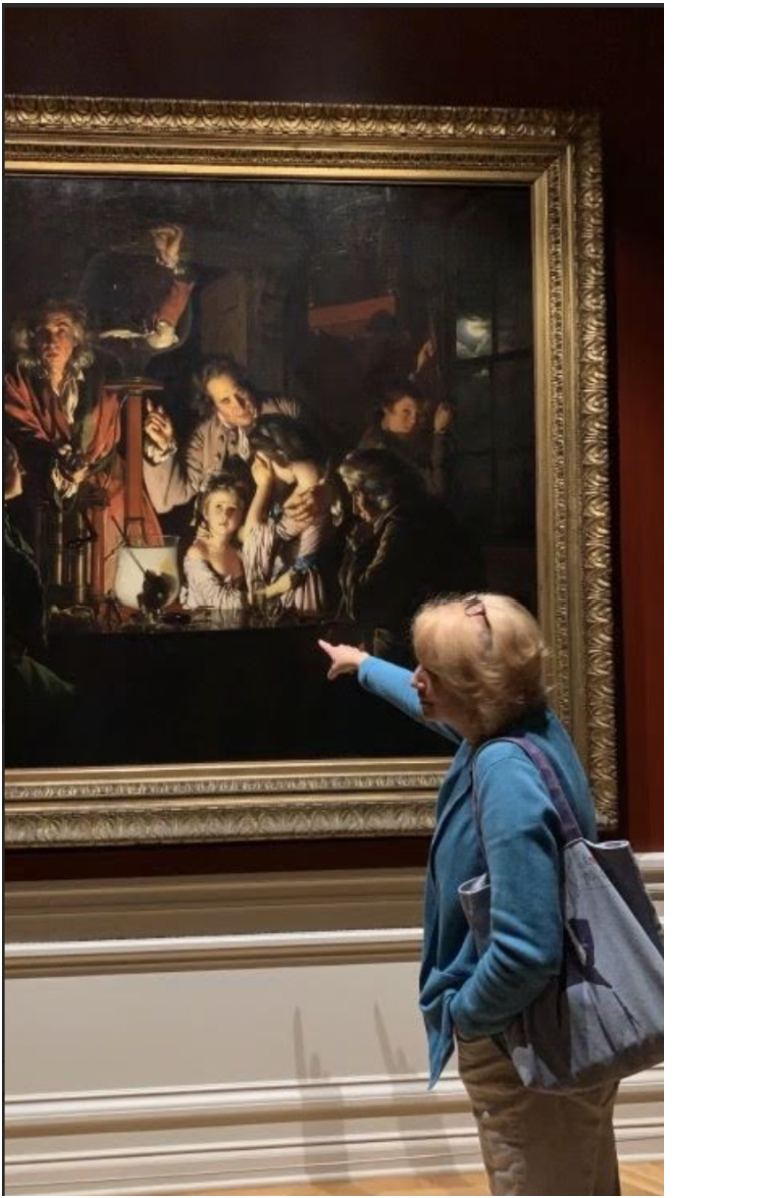
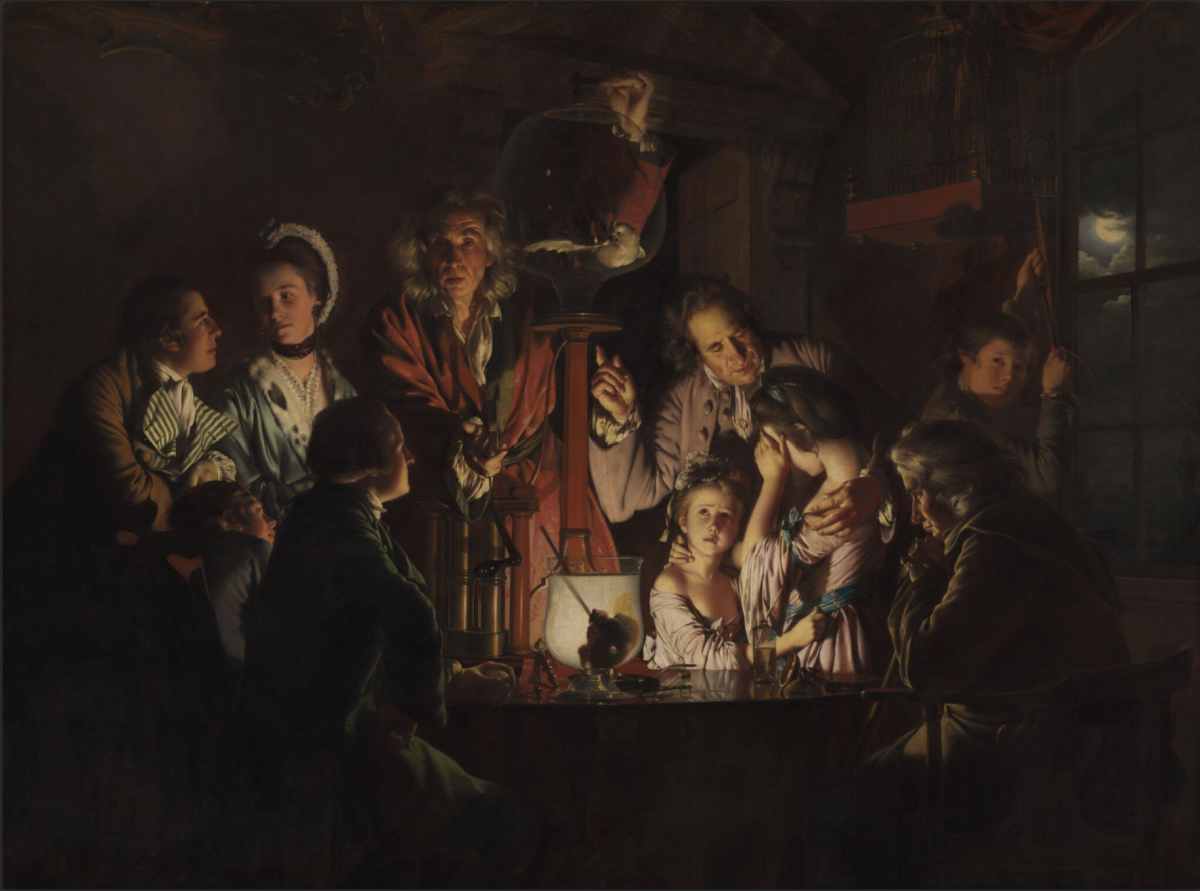
Dr. Geriguis references Joseph Wright of Derby’s 1768 painting An Experiment on a Bird in the Air Pump (a work she has been fortunate to see in real life) as a visual metaphor for the College of Arts and Sciences. The painting captures a moment where art, science, and human emotion converge—where curiosity and compassion coexist. For her, it embodies the essence of a liberal arts education: the meeting of discovery and reflection, of experiment and empathy. In the same way, she sees the College as a space where disciplines intertwine to illuminate what it means to be both human and in pursuit of knowledge.
Her vision is one of collaboration and adaptability. “Every year since COVID, education has changed,” she reflects. “Students’ needs evolve, technology advances, and we have to evolve too. My hope is to keep building networks of colleagues who can respond creatively to those changes, who can support one another as we navigate what’s next.”
For Dr. Geriguis, that constant process of learning and adapting is what keeps her inspired. “Whether in the classroom or in administration, it always comes back to learning,” she says. “We’re all still figuring it out together, and that’s what makes it meaningful.”
– Halle Reese, Class of 2027: History, Pre-Law